1,418 days of war
'I consider Ukrainians to be the best warriors. Ukrainian warriors are loyal until death.'
(Wilhelm Habsburg (Vasyl Vyshyvany))
The Great Patriotic War lasted 1,418 days. Russia's full-scale invasion of Ukraine has lasted just as long – 1,418 days.
For 1,418 days, Ukraine has been defending not only itself but also all of Europe from a nuclear imperial dictatorship. Ukraine stands as Europe's frontier, where the continent's fate is determined in the confrontation with Asian authoritarianism.
Historically, Ukrainians have always fought not only for their own freedom. At the cost of tens of millions of its own people's lives, Ukraine has repeatedly shielded the freedom of European nations, taking the brunt of the blow from the forces of civilisational regression. These forces came to Europe not only from the East, from Asia, but also, at times, emerged within Europe itself in the forms of Bolshevism and fascism...
Thanks to Ukraine's contribution to the victory over Nazi Germany in World War II (1939-1945), millions of lives were saved, both of other European peoples and Americans. By the time the Western Allies opened a Second Front in Europe in 1944, Ukrainians had already spent three consecutive years destroying the Wehrmacht's elite units, reducing the threat, including to the United States, and thus saving the lives of their soldiers. In fact, thanks to the 10 million Ukrainians who died, three million of whom were in active service, the United States avoided the need to land in Western Europe until 1944. It is a historical fact that more than 70% of German divisions fought on the Eastern Front, and their destruction, to which Ukrainians contributed significantly, saved the lives of millions in the West, including Americans.
Ukraine was the scene of decisive battles in that war: the Kyiv defensive operation (1941) diverted the main forces of the Wehrmacht from Moscow at a critical moment; the battles near Kharkiv (1941-1943) distracted Hitler's troops from other strategic directions, and Ukrainian reserves determined the outcome of the Battle of Stalingrad. The Battle of the Dnipro became one of the largest in world history (1943). Meanwhile, the Korsun-Shevchenkivskyi and Lviv-Sandomierz operations (1944) secured the liberation of Central Europe and, together with the breakthroughs by the forces of the four Ukrainian fronts, paved the way to Berlin and its capture.
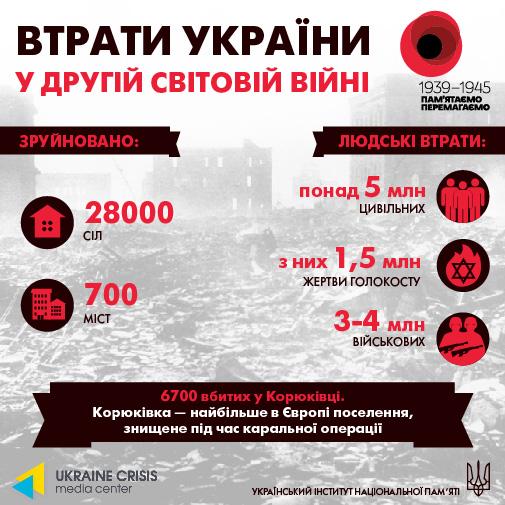
The struggle against Russian Bolshevism claimed the lives of tens of millions of Ukrainians. From the perspective of world history, the sacrifices of Ukrainians were not in vain; they weakened the potential advance of Bolshevism in Europe and the world. Yet the cost for the Ukrainian people was catastrophic. The genocide of the Ukrainian people as a result of the famines created by the Bolsheviks claimed the lives of more than two million Ukrainians from 1921 to 1923, about ten million from 1932 to 1933, and about one million from 1946 to 1947. This toll adds to the multi-million casualties of World War I, the Russian Revolution, and the Civil War, decades of Ukrainian struggles for national liberation under the new Bolshevik empire, and the victims of Stalinist repression...
British researcher Lancelot Lawton warned about this in London even before the start of World War II: "...Ukrainian Nationality is a Reality with at least a thousand years of authentic history behind it. No nation has struggled more valiantly to assert its independence than it has done; the soil of Ukraine is soaked in blood... Ukraine's oppressors ensured that it remained unknown; they denied even its existence. It is hard to imagine anything more worthy of condemnation than the silence over a people that by ancient right belongs to the family of European nations... The fate of Europe will depend on the resolution of the Ukrainian problem' (speech by Lancelot Lawton in the House of Commons of the British Parliament on 29 May 1935 with a report on 'The Ukrainian Question'). (https://www.istpravda.com.ua/articles/2011/04/7/34771/)
In 1935, Lancelot Lawton's words in the British Parliament were not heard by the world's leading powers. The war against Ukraine, unleashed by Russia in 2014, has, de facto, brought the world to the brink of World War III in our century. With the opponents' arsenals of nuclear weapons capable of destroying life on our planet...
The heroic struggle of the Ukrainian people today to defend European values against the second most powerful nuclear state in Eurasia is a reason to think about the future of our continent. In essence, this is a struggle for democracy against authoritarianism.
Ukraine has repeatedly taken blows from the forces of civilisational regression. These blows were not directed solely against Ukraine. Russia's current war against Ukraine is not just an attempt to restore an empire. At least the former Soviet empire, albeit in words, professed 'universal communist brotherhood of the proletariat'. The new nationalist-chauvinist empire in Russia, if created, will not stop at territorial expansion in Ukraine.
Russia currently proclaims all of Europe and the 'collective West' as its enemies, which are supposedly a direct threat to it. But they are an obstacle to the construction of a 'special Russian world' with its 'own civilisational path' and ambitions for world leadership.
By halting this large-scale war, which could have spread beyond Eastern Europe, Ukraine today acts as a shield of European security. The Ukrainian people have made unprecedented human, economic and resource losses for Europe in defence of the international legal order since the Second World War. NATO member states' troops are not involved in combat operations, thanks to Ukraine's resolute resistance. Every Ukrainian soldier defending the front line reduces the risk of direct confrontation between NATO and Russia.
European leaders must remember that the fate of not only Europe but the whole world today depends on Ukraine's fate.
Блог автора – матеріал, який відображає винятково точку зору автора. Текст блогу не претендує на об'єктивність та всебічність висвітлення теми, яка у ньому піднімається. Редакція "Української правди" не відповідає за достовірність та тлумачення наведеної інформації і виконує винятково роль носія. Точка зору редакції УП може не збігатися з точкою зору автора блогу.