Theses for a Plan and Strategy to Rebuild Ukraine – USSM (Part 4)
"Justice being taken away, then, what are kingdoms but great robberies?"
(Augustine of Hippo, Christian theologian and church leader)
The first step toward overcoming Ukraine's foreign policy, economic, energy and financial dependence, fighting corruption, and stimulating the growth of the middle class as the social foundation for democracy should be the introduction in Ukraine of 'a Unified State System for Monitoring the Production, Supply, Transportation, Consumption, and Payment for Fuel and Energy Resources and Housing and Utility Services' (the USSM).
The fact that, during Ukraine's years of independence, none of its governments has managed to implement such a SYSTEM indicates that genuine patriotism has been replaced by narrow-minded party egoism on the part of the political forces that formed those governments, as well as the lack of professional competence – at best – and total corruption – at worst – of their political leaders.
As a result, Ukraine has not yet determined which ECONOMIC MODEL is in line with its NATIONAL INTERESTS, and its governments have lacked a STRATEGY for economic recovery and strengthening the social foundation of DEMOCRACY. First and foremost, this should be achieved by overcoming POVERTY and expanding the MIDDLE CLASS in Ukraine.
The lack of government programmes and strategies to support small and medium-sized businesses, as well as to raise the salaries of teachers, doctors, military personnel, creative and scientific intelligentsia, civil servants and highly skilled workers in the real sector of the economy and industry, demonstrates that Ukrainian governments have lacked both an ideological framework and concrete plans for the development of DEMOCRACY in Ukraine.
From the very first years of independence, an indicator of this should have been a state strategy and corresponding programmes for developing housing and communal services (HCS) and for controlling tariffs for these services. The latter, as is well known, should be linked to the real incomes of the population.
Let me remind you that in the West, owning your own home, unburdened by debt and bank loans, is an important criterion for belonging to the middle class. In Ukraine, a law 'On the Privatisation of the State Housing Fund' was passed back in 1992. According to this law, almost 98% of the state and municipal housing fund was privatised free of charge. This made Ukraine one of the countries with the highest levels of housing privatisation in the world.
Despite the varying quality of housing and its physical deterioration, this created favourable conditions for the formation of a middle class, especially in cities, even by Western European standards. Subsequently, it was necessary to build the architecture of a RULE-OF-LAW STATE that would meet the standards of EUROPEAN DEMOCRACIES based on the supremacy of law and nationally oriented models of the ECONOMY, ARMED FORCES, DIPLOMACY, and INFORMATION POLICY.
That is, everything that directly affects the quality and standards of life of citizens, their security, the state's defence capability, and its international authority. This, in turn, determines the value and capitalisation of the assets of citizens and the country, the market value of real estate, land, and national wealth.
Ukraine's rich natural resources and the level of development of its scientific and industrial base provided opportunities for flexible regulation of household incomes, minimising the share that had to be spent on housing and communal services. In the absence of corruption in the governing bodies, this would have been sufficient to gradually bring incomes closer to the highest standards in Europe and utility payments closer to the lowest.
That is, everything that directly affects the quality and standards of life of citizens, their security, the state's defence capability, and its international authority. This, in turn, determines the value and capitalisation of the assets of citizens and the country, the market value of real estate, land, and national wealth.
Ukraine's rich natural resources and the level of development of its scientific and industrial base provided opportunities for flexible regulation of household incomes, minimising the share of spending on housing and communal services. In the absence of corruption in the governing bodies, this would have been sufficient to gradually bring incomes closer to the highest standards in Europe and utility payments closer to the lowest.
Ukraine's political elites have not yet coped with this task. Despite the fact that, de jure, according to the Constitution, the land, its subsoil, and mineral resources belong exclusively to the people of Ukraine. De facto, they have been used until now and continue to be used exclusively in the interests of private businesses close to and connected to the government.
The USSM's absence creates a favourable legal environment for impunity, which is the basis for political corruption and the emergence of full-fledged oligarchs in Ukraine. It also facilitates the establishment of an oligarchic-clan system of pseudo-democratic governance at the central level and a feudal-clan system at the local level.
During 1991-2000, the state still covered part of utility costs, and most Ukrainians paid 2-5% of their total income for them. However, incomes themselves almost stopped growing and consistently approached the lowest in Europe. After peaking in 2004 (12.1%), the highest in Europe that year, Ukraine's economic growth has been steadily declining. Instead of industrial, innovative and high-tech economic development, a model of being a raw-material appendage to the world's more developed economies was chosen. This has led to the almost dumping-like plundering of Ukraine's national wealth.
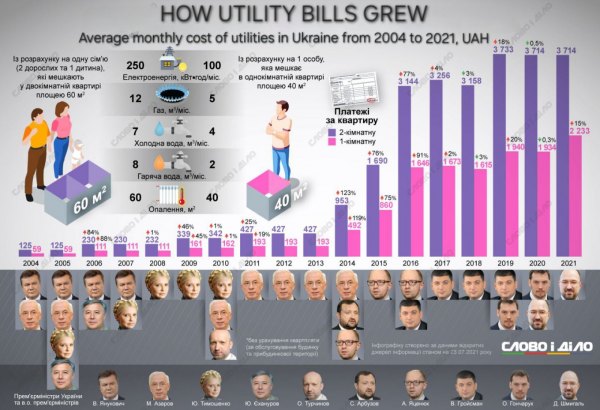
Today, salaries in EU countries are 5-10 times higher than in Ukraine. However, Ukrainians pay 30-50% of their income for utilities, while EU citizens pay 15-20%.
Statistics show the following trend in changes in the share of total household income spent on utilities in Ukraine since 1991:
1991-1994 (President L. Kravchuk) – 2-5%;
1996-2000 (President L. Kuchma) – 5-10%;
2001-2010 (Presidents L. Kuchma, V. Yushchenko, V. Yanukovych) – 10-15%;
2011-2014 (President V. Yanukovych) – 15-20%;
2015-2025 (Presidents P. Poroshenko, V. Zelenskyy) – 30-50%.
One of the main reasons for the systemic and massive corruption in Ukraine's energy sector is the lack of a 'Unified State System for Monitoring the Production, Supply, Transportation, Consumption and Payment for Fuel and Energy Resources and Housing and Utility Services' (USSM).
1991-2005
Since 1991, none of Ukraine's governments has had any real baseline figures on the supply and sale of national energy resources. Consequently, these figures have not been used either in planning the state budget or in forecasting the development of the national economy. It is like planning a family budget and purchasing goods and services without knowing the real income of family members.
Macroeconomic planning in Ukraine has never had a reliable financial and economic basis in the form of a documented, consolidated energy balance for Ukraine. This has always created 'legal loopholes' for impunity and the existence of gigantic corruption schemes involving the theft of Ukraine's energy resources. The recent criminal proceedings involving former Minister of Energy H. Halushchenko and officials of Energoatom also have their roots in this problem...
2005-2010
It is particularly regrettable that, just before the 2004 Orange Revolution, all preparatory work for implementing the USSM in Ukraine was almost complete. During 2002-2003, under the control and coordination of the National Security and Defence Council (NSDC), the Cabinet of Ministers developed a draft law for adoption by the Verkhovna Rada (Parliament) of Ukraine. However, the new president, V. Yushchenko, and the NSDC secretary, P. Poroshenko, lost interest in it after taking office. Previously adopted NSDC decisions ceased to be implemented, and the NSDC apparatus stopped monitoring their implementation by the government.
2010-2014
The next attempt to implement the USSM was made only seven years later. Under pressure from the EU and Ukraine's professional elite, the Verkhovna Rada passed bill No. 9572 in its first reading in June 2012. It incorporated many years (mainly up to 2005) of work by experts and scientists from the National Academy of Sciences (NAS) of Ukraine, industry institutes, and former NSDC staff members. However, the already entrenched corrupt 'energy lobby', both within the government and among the oligarchs, blocked and derailed further consideration of Bill No. 9572 in the Verkhovna Rada of the sixth convocation.
The members of parliament, in violation of the statutory deadlines for considering the bill and without completing the procedural steps necessary for its second reading, simply 'buried' this bill, which was critically important for the state.
After the re-election of the Verkhovna Rada in October 2012, Bill No. 9572 was removed from consideration altogether. To do this, they exploited loopholes in the parliamentary Rules of Procedure, which do not take into account the importance of the bill to Ukraine's national security, and therefore, the newly elected parliament does not consider bills that its predecessors did not have time to adopt. Regardless of their importance and the resources invested by the state in their preparation, they are considered to have been removed from consideration by the previous convocation.
Unfortunately, it has become a 'political tradition' in Ukraine that large-scale corruption cases are rarely investigated due to the inaction of senior state officials. The multi-billion-dollar losses to the budget due to the absence of a law on the USSM and the continued preservation of corruption schemes in the energy sector continued.
The corruption schemes for embezzling Ukraine's energy resources, invented back in the 1990s, have only become more sophisticated over time. Another 'political tradition' was that every new presidential candidate proclaimed the need to fight corruption. During the elections, they usually promised to break the corruption schemes in the energy sector. Yet once in power, such promises were quickly forgotten. Only the top of the 'energy schemes' changed, with the beneficiaries becoming 'close friends,' loyal associates, or new intermediaries connected to oligarchic groups. Cash flows were redirected, and the Verkhovna Rada 'forgot' about the need to adopt the law on the USSM.
2014-2019
Another attempt to introduce the USSM was made three years later, in June 2015, again under pressure from the Western partners and non-partisan professionals who still had some access to the media. The Verkhovna Rada adopted a new bill, No. 1640, 'On the Unified State System for Monitoring the Production, Supply, Transportation, Consumption and Payment for Fuel and Energy Resources and Utilities' in the first reading. It shared the fate of Bill No. 9572. Under the old sabotage scheme, it was also not considered in the second reading and did not become law because the 'energy lobby' used the old mechanism of bureaucratic manipulation.
The 'legislative games' continued with the next bill, No. 4844, with a new title, 'On a Unified State System for Monitoring in the Field of Energy and Utilities'. This bill repeated the sad fate of its predecessors: although it was adopted by Parliament in the first reading (in September 2016), the second reading never took place.
If Ukraine's state pyramid had been built according to the laws of democracy (https://blogs.pravda.com.ua/authors/smeshko/6989c011528d0/), such procedural manipulations with these bills would have long been the subject of criminal investigations. After all, the state's economic and defence strength, as well as the state of the fight against systemic corruption, directly depend on the USSM's existence.
A genuine PARLIAMENTARY OPPOSITION should have initiated appropriate criminal investigations. For example, on the grounds of such offences:
- by the chairpersons of the Verkhovna Rada, who, under Article 88 of the Constitution of Ukraine, were supposed to ORGANISE the work of parliament and ENSURE compliance with its Rules of Procedure;
- heads of the Government, who, under Article 113 of the Constitution, have the right to SUBMIT bills to the Verkhovna Rada and SUPPORT them in the relevant parliamentary committees;
- Secretaries of the National Security and Defence Council, who, under Article 4 of the Law 'On the National Security and Defence Council of Ukraine,' DEVELOP and COORDINATE measures on ENERGY SECURITY issues and MONITOR the implementation of decisions in the field of national security.
Finally, the parliamentary opposition could also have initiated criminal investigations into possible violations by the presidents of Ukraine, who, under Article 102 of the Constitution of Ukraine, act as its guarantors and must ensure and control the implementation of the Constitution and the laws of Ukraine.
2019-2026
After the 2019 presidential election, the new government traditionally 'forgot' about the existence of the problem of the absence of the USSM in Ukraine, as well as about the DEMOCRATIC PRINCIPLE of the temporary nature of any government ELECTED BY THE PEOPLE, the obligation to implement the Constitution, previous laws and the continuity of the country's NATIONAL INTERESTS.
According to these principles and the current Constitution of Ukraine, the elected government is obliged to implement state decisions adopted by the previous government in accordance with the Constitution and laws of Ukraine. The rule of law is one of the main principles of democracy, and the issue of the USSM is linked not only to overcoming poverty, but also to national energy, economic, financial and defence independence. It is also linked to overcoming corruption at the highest levels of power in Ukraine. Victory over such corruption would be crucial for solving many other strategic problems in the economy, defence, social and law enforcement spheres.
In 2026, independent Member of Parliament Dmytro Razumkov stated: "The radiators are cold, there is no hot water, or it is barely warm, and electricity disappears for hours or even entire days. Ukrainians are being asked to tighten their belts and endure, while someone is profiting from price differences and schemes during the war!" (https://www.facebook.com/share/v/1CPVy6p3AZ/?mibextid=wwXIfr). However, the former Chairman of the Verkhovna Rada of the ninth convocation (29 August 2019 – 7 October 2021) from the mono-majority forgot to remind Ukrainians that, after 2019, no new bill to introduce the USSM was submitted to the Verkhovna Rada.
Appeals and reminders from experts have been ignored to date. Only a statement from the Government has appeared, expressing its 'intentions' to 'digitise' the energy sector, which is more populism and cynicism than professionalism and state responsibility.
In summary, politicians who have been in power in Ukraine over the past 30 years have created a system conducive to large-scale corruption in the energy sector of the economy.
This corruption has long since penetrated the highest echelons of power, resulting in the massive misappropriation of Ukraine's national wealth.
The main areas of this corruption are:
- manipulation of energy resource accounting due to opaque accounting practices, fragmentation and the impossibility of reliably verifying key data – for example, the amount of gas, oil, coal and electricity that was actually extracted or produced and consumed in Ukraine;
- understatement of actual production volumes: companies conceal part of their energy resource production to reduce rent payments, thereby causing direct losses to the Ukrainian budget;
- shadow schemes in extraction and transportation: 'grey' extraction (the absence of a monitoring system allows for the existence of illegal extraction of hydrocarbons and coal, which are not reliably accounted for by anyone in the state);
- theft during the transportation of energy resources (e.g. gas or oil) is possible, resulting in unauthorised 'losses' that are virtually impossible to document without automated state monitoring;
- manipulation in the financial sector: unreasonably low rent payments for raw materials compared to world prices, underestimation of production volumes, artificial reduction of taxes payable to the budget;
- theft from the budget through fictitious and inaccurate data on subsidies: without reliable data on energy consumption in the country, subsidies or grants are stolen based on false data;
- the impossibility of scientifically sound budget planning and forecasting of Ukraine's economic development due to the lack of an energy balance in the country: the lack of reliable data on the country's energy resources and consumption makes professional budget planning impossible and conceals systemic corruption and embezzlement of Ukraine's national wealth;
- creation of favourable conditions for corruption schemes in public procurement: the lack of a system of state monitoring and control over energy resources leads to the theft of funds during the sale of energy resources and public procurement;
- creating opportunities for abuse of power and political pressure on local government bodies: without official data from a centralised energy resource accounting system, local government bodies are vulnerable to selective manipulation for the purposes of corruption or political gain;
- creating conditions for conflicts of interest and increased corruption in state authorities: representatives of state authorities, having non-transparent relationships with business structures, can give them preferences and receive benefits for this, while non-transparent accounting and control allow them to hide real data and theft;
- loss of trust among international partners and a decline in Ukraine's investment attractiveness: the lack of a clear and transparent energy resource accounting system, caused by systemic corruption and impunity of the state apparatus, demonstrates the absence of the rule of law in Ukraine. As a result, this has a knock-on effect, reducing the capitalisation of all enterprises and companies, as well as the market value of land and all real estate in Ukraine.
Even the most conservative estimates show that over the last 20 years, Ukraine's state budget could have lost 120-160 billion US dollars solely due to the lack of the USSM.
The structure of these losses is as follows: shadow oil and gas production – $40-50 billion, dumping of nuclear electricity – $7-30 billion, fictitious subsidies and grants – $10-15 billion; accounting manipulations, theft and losses from inefficient use – $5-10 billion; other corruption schemes in the energy sector – $20-30 billion.
In fact, we are talking about a systematic, long-term drain on national wealth that has not only undermined the state's financial stability but also limited its economic, social and defence capabilities.
Theses for a Plan and Strategy to Rebuild Ukraine (Part 1)
Theses for a Plan and Strategy to Rebuild Ukrainian Economy (Part 2)
Theses for a Plan and Strategy to Rebuild Ukraine (Part 3). Formula for Economic Growth
Блог автора – матеріал, який відображає винятково точку зору автора. Текст блогу не претендує на об'єктивність та всебічність висвітлення теми, яка у ньому піднімається. Редакція "Української правди" не відповідає за достовірність та тлумачення наведеної інформації і виконує винятково роль носія. Точка зору редакції УП може не збігатися з точкою зору автора блогу.