The Budapest Memorandum as a Foundation for Restoring the System of International Law and the Rule of Law in The World
"The system of international law is sustained by mutual recognition of the foundations and principles which, regardless of their metaphysical origins, FUNCTION in practice as the RULES OF THE GAME. The well-known principle of 'pacta sunt servanda' (Latin for 'agreements must be kept') embodies a COHESIVE SYSTEM and the basis for COMPATIBLE PARTICIPATION in the common game. Once one of the parties ceases to abide by the rules, the entire SYSTEM OF INTERNATIONAL LAW collapses" (Johan Huizinga, Dutch historian and philosopher)
On 2 March 2026, the Ukrainian diplomat Serhii Kyslytsia, in his article 'Differences between the English and Ukrainian versions of the Budapest Memorandum', stated that: "... In 1994, Washington carefully ensured that neither its correspondence with Yeltsin and its allies nor the document itself contained any reference to 'guarantees.' Washington was neither ready nor willing to provide guarantees. The US turned a blind eye to the foreign-language versions of the Memorandum, since the 1994 Budapest Memorandum had no legal force (!?) and was never ratified by the signatory countries – Ukraine, the US, the UK, and Russia..." (https://www.istpravda.com.ua/columns/2026/03/2/165723/).
I consider it appropriate to respond to this article. All the more so as it was authored by an official representative of the negotiating group involved in diplomatic negotiations with the Russian Federation.
It is therefore necessary to reiterate the facts.
On 5 December 1994, the presidents of Ukraine, the US and Russia, as well as the Prime Minister of the UK, signed an international treaty: 'Memorandum on Security Assurances in Connection with Ukraine's Accession to the Treaty on the Non-Proliferation of Nuclear Weapons'. China and France acceded to this treaty by means of corresponding governmental statements, namely: the statement by the Government of the People's Republic of China dated 4 December 1994, and the declaration by the French Republic, accompanied by a letter from President François Mitterrand, dated 5 December 1994.
Under the treaty, which has been given the working title 'Budapest Memorandum', Russia, the United States, the United Kingdom, France and China provided Ukraine with guarantees of its security and territorial integrity in exchange for its commitment to renounce nuclear weapons and accede to the Treaty on the Non-Proliferation of Nuclear Weapons as a non-nuclear-weapon state.
Under this agreement, commonly referred to as the Budapest Memorandum, Russia, the United States, the United Kingdom, France, and China provided Ukraine with assurances of its security and territorial integrity in exchange for its commitment to relinquish nuclear weapons and to accede to the Treaty on the Non-Proliferation of Nuclear Weapons as a non-nuclear-weapon state.
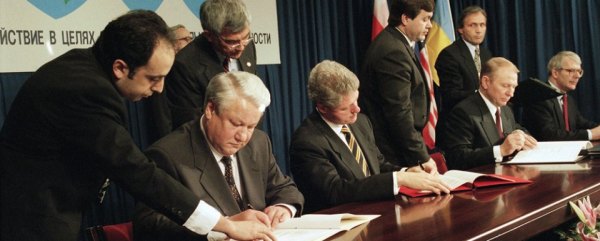
Following a submission by the signatory states of the Memorandum to the UN General Assembly and the UN Security Council, it was officially registered as an international treaty – an official document of the UN General Assembly and the UN Security Council. The submission bears the signature of Sergey Lavrov, Minister of Foreign Affairs of the Russian Federation, who in 1994 served as Russia's Permanent Representative to the UN. The text of the treaty was included in the agenda of the UN Security Council session in 1995 and circulated as an official document of the UN Security Council.
In accordance with the 1969 Vienna Convention on the Law of Treaties, the Budapest Memorandum is a fully-fledged international treaty, binding upon all its signatories. Under the principle of Roman law, 'pacta sunt servanda', and Article 26 of the Vienna Convention: "Every treaty in force is binding upon the parties to it and must be performed by them in good faith."
Failure to comply with or disregard this principle results in the collapse of the entire SYSTEM. First and foremost, it signifies the legal demise of the 1969 Vienna Convention on the Law of Treaties, for which there is currently no substitute. How can there be any trust in any new documents or agreements regarding new 'guarantees'? On what basis of international law could such agreements be concluded to replace the 'old' ones that have been declared 'invalid'?
Regarding speculation on the subject of the 'inappropriate title of the document" and the "lack of ratification". From an international law perspective, the title of the document is irrelevant. Every copy of the treaty in different languages has equal legal force. Playing on the interpretation of the English words "guarantees" and "assurances" is of no consequence to Ukraine. In the copies of the treaties in Ukrainian and Russian, which all parties signed, the word "guarantees" is unambiguous. Just as an insurance policy in the US and the West is a binding guarantee of its performance, even though its title contains the English word "insurance" rather than "guarantee".
According to Article 2 (1) (a) of the Vienna Convention on the Law of Treaties, an international treaty is defined as "an international agreement concluded between States in written form". It must be signed by heads of state, heads of government or ministers of foreign affairs, acting on behalf of their governments. The Budapest Memorandum was concluded in written form and signed by the heads of state and government of the signatory countries.
Pursuant to Article 11 of the Vienna Convention, the consent of a State to be bound by a treaty may be expressed by signature, ratification, or by any other means if so agreed. The first is by implication. The second and third options must be expressly provided for in the text of the treaty. The Budapest Memorandum contains no provision requiring ratification for its implementation. Furthermore, it was verified as a valid and fully-fledged international treaty upon registration with the UN, in accordance with Article 102 of the UN Charter.
The Budapest Memorandum is the cornerstone of diplomatic instruments to ensure our security, defence and territorial integrity.
During the annexation of Crimea in 2014, the Ministry of Foreign Affairs should have initiated an active and proactive strategy to protect Ukraine's territorial integrity and ensure its security and defence through diplomatic channels, as required by law and the relevant resolutions of the Parliament of Ukraine. When the so-called 'little green men' (unmarked Russian soldiers) appeared in Crimea, diplomatic notes should have been sent calling for consultations among the signatory states of the Budapest Memorandum. Collective defence by NATO member states, pursuant to Article 5 of the Alliance Treaty, likewise begins with consultations.
At the same time, a démarche should have been undertaken in the UN Security Council regarding Russia's violation of the treaty, demanding that, following the introduction of martial law in Ukraine, Russia be officially recognised as an aggressor state, and its vote in the UN Security Council on matters of war and peace in Ukraine be blocked. Plans should have been presented to accompany such actions with public diplomacy and media intervention in the signatory countries and the West. The 'China card' should have been played as a significant factor in global influence and, first and foremost, on Russia. China has always reaffirmed its commitments to Ukraine, in accordance with the Budapest Memorandum.
Attempts to justify this inaction by claiming that the Memorandum is merely "a scrap of paper," that it contains "weak wording," or that it lacks "implementation mechanisms" are nothing but manipulations. They do not stand up to scrutiny under international law and appear to serve hidden "political games," evidently aimed at preserving personal positions and concealing official inaction. Unfortunately, it is characteristic of politicians worldwide to shift the blame for their own selfishness, cowardice, inaction, incompetence and professional ignorance onto the "imperfections" of laws and international treaties.
The window of opportunity for the active use of the Budapest Memorandum as the only possible diplomatic platform for negotiations, where Ukraine truly possesses significant diplomatic 'trump cards', existed even before the full-scale invasion on 24 February 2022. (https://blogs.pravda.com.ua/authors/smeshko/62151173a480b/). With the political will and professional competence of the state leadership, even the invasion itself could have been prevented through diplomatic means (https://blogs.pravda.com.ua/authors/smeshko/67cb50126ccbd/).
Ukraine's diplomatic trump cards have been and remain both the Budapest Memorandum and the actions of our diplomatic service, which are carried out exclusively in accordance with the norms of international law: the 1969 Vienna Convention on the Law of Treaties, the 1975 Helsinki Accords, Article 56 of the UN Charter, Article 4 of the Law of Ukraine "On the Defence of Ukraine" and Article 85 of the Constitution of Ukraine. The United States should be consistently reminded not only of the Memorandum but also of the Charter on Strategic Partnership, which remains in force.
In particular, it states: "The US confirm the importance of the security assurances described in the Trilateral Statement by the Presidents of the U.S., Russian Federation and Ukraine of January 14, 1994, and the Budapest Memorandum on Security Assurances in connection with Ukraine's accession to the Treaty on the Non-Proliferation of Nuclear Weapons of December 5, 1994." (Preamble, para. 4). (https://blogs.pravda.com.ua/authors/smeshko/680a926b137ec/)
Is it really not clear by now that any statements from the Ukrainian side which undermine trust and ignore this fully-fledged and valid international treaty constitute direct support for the aggressor state? In effect, this plays into the Kremlin's hands in its attempt to portray the agreement as lacking binding legal force and to evade responsibility for its aggression against Ukraine. The Kremlin is already doing everything possible to remove the 'memorandum issue' from the international agenda and to avoid discussions of how it undermines the SYSTEM of international law by failing to fulfil its security obligations. (https://blogs.pravda.com.ua/authors/smeshko/68ff681c23932/)
The question arises: how can Ukraine expect support from the United States and the West if Ukrainian diplomacy itself undermines the Memorandum?
Whilst the Budapest Memorandum is recognised as a valid international treaty and is referred to in the text of the Joint Statement of 10 August 2025 by President of France Emmanuel Macron, Prime Minister of Italy Giorgia Meloni, Federal Chancellor of Germany Friedrich Merz, Prime Minister of Poland Donald Tusk, Prime Minister of the United Kingdom Keir Starmer, President of the European Commission Ursula von der Leyen, and President of Finland Alexander Stubb, 'On Peace for Ukraine'. The statement was made in Brussels ahead of the summit between US President Trump and President Putin. It cemented Europe's common position on diplomatic support for Ukraine. (https://blogs.pravda.com.ua/authors/smeshko/6899fefc8907f/)
US Secretary of State Marco Rubio, then a senator, on 25 March 2014, highlighted the significance and impact of this treaty on the global SYSTEM of international law, nuclear disarmament, non-proliferation, and the rule of law in the world. Speaking in the US Congress during the events surrounding the annexation of Crimea, he stated:
"When the Soviet Union fell in the early 1990s, Ukraine was left with the third largest stockpile of tactical nuclear weapons and strategic nuclear weapons on the planet. But they signed this agreement (the Budapest Memorandum) with the United States, the United Kingdom (UK) and Russia that basically said: if you give up your nuclear weapons, we, these three countries that signed this, will provide for your defence and assure you of your defence. And so Ukraine did that. They gave up these weapons. This was signed in 1994. Twenty years later, one of the three countries that signed this agreement has not just provided for their defence, but they actually invaded them.
And I want to make a point on this for a second. Think about it, if you're one of these other countries around the world right now that feels threatened by your neighbours, and the United States and the rest of the world are going to you saying, listen, don't develop nuclear weapons, we will protect you, we will make watch out for you. What kind of lesson do you think this instance sends to them? I think it sends a message to many countries around the world that perhaps we can no longer count on the security promises made by the free world..." (https://blogs.pravda.com.ua/authors/smeshko/67cb50126ccbd/).
Another influential US Senator, Ted Cruz, also reaffirmed the US's obligations under the Budapest Memorandum in February 2022:
"You might ask: Why should the US honour its commitments? Why should we honour our commitments under the Budapest Memorandum? Why should we fulfil our treaty obligations to NATO countries? Because one way to protect US national security is that, when we enter into a treaty with a country, when we enter into a legal agreement – we honour our commitments. And we want countries to know that we stand by our friends, that we keep our word, and that the treaties we have signed matter. After all, if countries come to the conclusion that, under a weak and helpless president, our treaties, our legally binding agreements, are worthless, this undermines the ability of any US president to enter into treaties with our friends and allies that ensure the safety of Americans." (https://www.cruz.senate.gov/newsroom/press-releases/sen-cruz-on-the-crisis-in-ukraine-president-biden-and-the-democrats-have-imperiled-ukraine-and-put-europe-on-the-brink-of-war)
On 19 October 2025, Günter Krichbaum, State Minister for European Affairs at the German Federal Foreign Office, stated: "We must remember that there is the Budapest Memorandum, in which Russia recognised the territorial integrity and sovereignty of Ukraine in exchange for the withdrawal of nuclear weapons. What has now happened to this agreement has not been forgotten".
Therefore:
The security assurances provided to Ukraine under the Memorandum remain valid and are not empty words or mere 'promises'. They were granted by an international treaty signed in accordance with the 1969 Vienna Convention on the Law of Treaties. No alternative international legal framework exists for concluding treaties. It is the party whose rights have been violated that must demand the treaty's implementation. The violators will not do so. The alternative to this is "playing on someone else's turf", by the rules of those who breach obligations and evade full compliance.
The "cards" Ukraine should bring to the negotiating table should include formal diplomatic notes calling for consultations with the guarantor states, along with their written responses. The agenda should be shaped by a plan and strategy developed in Kyiv.
(https://blogs.pravda.com.ua/authors/smeshko/69248e0365d8b/).
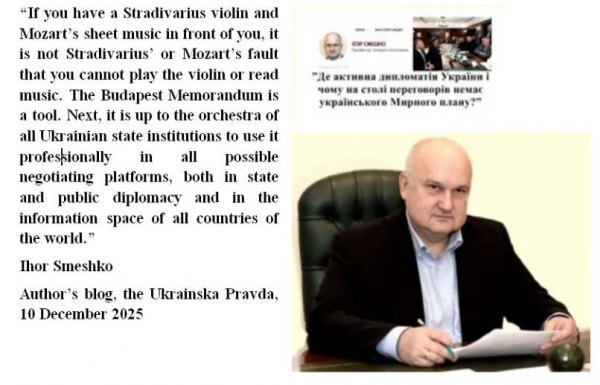
The Ukrainian delegation should comprise experienced, career diplomats with proven professional track records and appropriate international standing, rather than "effective managers".
Diplomacy is the science of the inevitable and the art of the possible. It involves the ability, guided by knowledge of the laws of the inevitable and the art of the possible, to forge appropriate strategic ties at the right place and time. It is impossible to become a diplomat 'off the street'.
Ukrainian version: "Будапештський меморандум як основа для відновлення системи міжнародного права і правопорядку у Світі" | https://blogs.pravda.com.ua/authors/smeshko/69bd656287687/
Блог автора – матеріал, який відображає винятково точку зору автора. Текст блогу не претендує на об'єктивність та всебічність висвітлення теми, яка у ньому піднімається. Редакція "Української правди" не відповідає за достовірність та тлумачення наведеної інформації і виконує винятково роль носія. Точка зору редакції УП може не збігатися з точкою зору автора блогу.