CORRUPTION: Causes and Genesis. Theses for the Plan and Strategy to Rebuild Ukraine (Part 6.1)
Those who buy power with money become accustomed to profiting from it
(Aristotle, 4th century BC)
The more corrupt the state, the more numerous the laws
(Publius Cornelius Tacitus, Roman historian, 1st-2nd century AD)
Ukraine's experience confirms the wisdom of these classical maxims. Laws and subordinate legislation that paved the way for corruption in Ukraine began to proliferate following the country's declaration of independence and the proclamation that it had become a "democratic state." As history demonstrates, a declaration of intent has never, by itself, automatically brought about the promised outcome. Building such a complex system of public governance as democracy requires a thorough understanding of the principles upon which it is founded (https://blogs.pravda.com.ua/authors/smeshko/68a5dd747bc1f/).
Moreover, what needed to be built was not merely a new "vertical of power", as was sometimes advocated by the "new-old" political establishment, but rather an entirely new "pyramid of power." These two concepts differ as much as a low-grade domestic Zaporozhets clunker differs from a luxury German Mercedes. None of the political pseudo-elites elected to power throughout the years of Ukraine's independence succeeded in accomplishing this task. Without a sound understanding of the principles of democratic governance, it was impossible to prepare for combating corruption, which is an inherent challenge even within democratic systems.
Government corruption and the shadow economy also existed in the USSR. But their scale was incomparable to the opportunities that opened up for shrewd dealers during the privatisation of state property and the uncontrolled liberalisation of the market. The example of the almost destitute fate of the families of the General Secretaries of the USSR after their dismissal from office, and the mass executions of corrupt officials in China today, are good illustrations of the difference in the scale of corruption under free market conditions.
The first two presidents of Ukraine acknowledged their ignorance of democratic law. President Leonid Kravchuk stated this in 2019: 'In 1991, we proclaimed that Ukraine had become a democratic state... We suddenly began to build a new state. We had no knowledge of the new SYSTEM, even though we were educated, people... But this knowledge was completely at odds with what we needed in the new Ukraine. This situation persists to this day' (https://day.kyiv.ua/article/podrobytsi-litnya-shkola-zhurnalistyky/tsi-vybory-mozhut-buty-nashoyu-ostannoyu-pomylkoyu).
The second president, Leonid Kuchma, even upon his appointment as Prime Minister in October 1992, addressed the members of the Parliament of Ukraine with a request: 'Just tell me what to build, and I will build it.'
Such ignorance meant that the privatisation carried out did not, as in neighbouring Poland, lead to the emergence of mass numbers of small and medium-sized business owners – the foundation of the MIDDLE CLASS, which serves as the social basis for building DEMOCRACY. On the contrary, its predatory nature towards the people of Ukraine led to a dramatic stratification of society and the emergence of the super-rich and, subsequently, full-fledged oligarchs. The latter soon gained control over parliamentary parties and the government, not only through 'puppet' MPs and ministers, but also through corrupt officials and law enforcement officers.
The 'shadow market' of the past and membership of the party and Komsomol nomenclature provided a good training ground for becoming extremely wealthy. Having acquired vast financial resources, some of them 'gained access to power'. This enabled them to 'buy' new power for themselves. The shrewdest became oligarchs. To quote Aristotle: 'Those who buy power with money become accustomed to profiting from it'. The process of 'investing in politics' becomes continuous and ever-present, whilst all the 'new political faces in power' become mere puppets in the deft hands behind the scenes of the puppet theatre of pseudo-democracy.
We must therefore soberly acknowledge that, throughout all the years of independence, no one in Ukraine has yet even begun the scientifically grounded construction of DEMOCRACY as a complex socio-economic SYSTEM. All the 'democratically branded' political parties and politicians who criticised the 'previous regime' for authoritarianism did so only in words. Once in power, they merely refined the authoritarianism that actually existed. They were content with authoritarian rule and the resource-based economic model, which form the basis for their own self-enrichment. And what they called democracy in words actually has another name: oligarchic-clan-based and regionally neo-feudal authoritarianism.
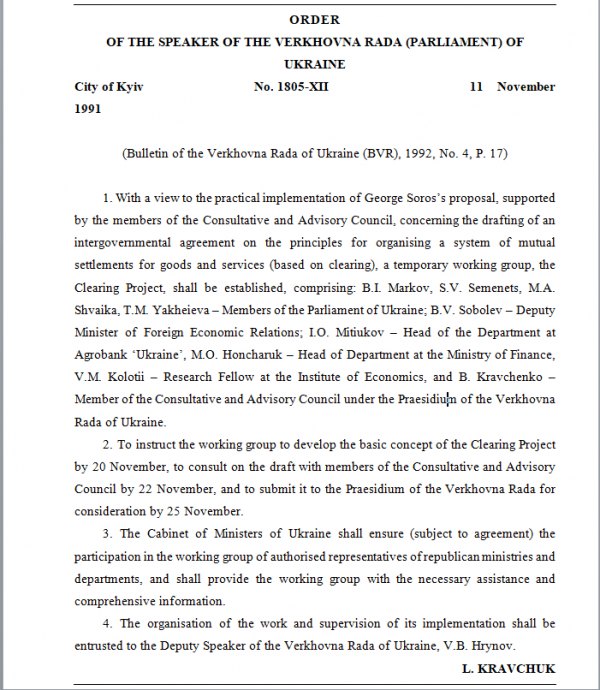
As for another marker of corruption, according to Tacitus: 'the more corrupt the state, the more numerous the laws', one of the first acts to pave the way for this can be considered Decree No. 1805-XII of the Speaker of the Parliament of Ukraine dated 11 November 1991 'with a view to the practical implementation of the ideas of George Soros' (https://zakon.rada.gov.ua/laws/show/1805-12#Text). This did not involve transferring knowledge on building democracy to Ukraine, which would have been desirable and understandable, for example, experience in developing branches of government independent of one another, genuine ideological parties committed to the principles of democracy rather than clan-based or leader-centred parties, and the creation of a legal framework, system, mechanism and procedures for overseeing government activities (https://blogs.pravda.com.ua/authors/smeshko/68a5dd747bc1f/).
No, Mr Soros's 'idea' lay elsewhere. The well-known transnational financier and 'globalist', who is said to have made a profit of 1 billion dollars from the collapse of the British pound sterling in a single day, on 16 September 1992, proposed introducing clearing settlements for goods and services in Ukraine. Naturally, this was to be carried out with his advisory assistance and mediation. The only problem was that Ukraine did not yet have any state system for assessing their value at world prices, analysing potential sales markets, assessing the reputation of counterparties, or a mechanism for monitoring settlements. Embassies abroad were only just being opened, intelligence agencies had not yet been established, and Ukraine's first Law 'On Intelligence' was only adopted in 2001, despite opposition from the then government and the leadership of the Security Service of Ukraine (SSU)...
However, the complete dismantling of Ukraine's entire legal framework and the opening of legal loopholes for corruption-which was already rampant-as well as the emergence of a multitude of laws and subordinate legislation that continue to fuel it to this day began in 2005. This is linked to the actions of Ukraine's third president, Viktor Yushchenko.
The first two presidents, at least, possessed a good education, broad-mindedness and experience of systematic public administration. They made fatal mistakes in their choice of personnel. They failed to establish new ideological parties that would be committed to the principles of democracy, which deprived them of the necessary pool of talent. The so-called 'personal loyalty' of their subordinates turned out to be a betrayal of both themselves and Ukraine. Yet they still understood the importance of professionalism and expertise. Their activities were scrutinised by a parliamentary opposition that was genuinely active in the Parliament. Public opinion in the country mattered, and the media were not yet under the complete control of either the authorities or the oligarchs. Some of them were openly opposed to the government.
The fragile balance of power among the branches of government and the existing political forces in Ukraine, as well as the resilience of the governing bodies-thanks to their still fairly competent professional capacity, painstakingly built over the previous years of independence-was destroyed by Ukraine's third president.
A Soviet-trained financier by education, lacking a systematic and broad-ranging view of the world, Viktor Yushchenko not only lacked knowledge of the principles of democracy, but also made no effort to seek out those who might have helped him in this regard. The transition from an authoritarian system of governance to a democratic one was not his objective. Lacking experience of independent governance in his previous posts, which had been characterised by his predecessor's authoritarian leadership style, he appears merely to have replaced a paternalistic model of serving the "father figure" with elements of narcissism, messianism, and self-admiration. Instead of showing gratitude to the people who had brought him to power in 2004, he believed he had already fulfilled his mission by 'bestowing freedom' and giving the world a 'new model of democracy'.
According to a long-standing friend and head of his administration, O. Rybachuk: '...When Viktor Yushchenko was running for the presidency, he did not set himself the task of changing the system at all... He had a well-known saying that on the day after the Kuchma regime collapsed, tens of thousands of Ukrainians would somehow come to power by themselves; all you had to do was remove that regime, and everything else would begin to grow on its own. He did not consider it his duty to put together this team; he did not formulate his own political agenda; he had no reform plan of his own; at one point, he even asked us to map out a year-long schedule of what he was supposed to do..." (https://www.rudenko.kiev.ua/interview/rybachuk-yushchenko-zmushenyy-velychezny).
Without changing the system of power, Yushchenko used the term 'revolution' as a pretext for the unconstitutional dismissal of tens of thousands of the most experienced professionals. In doing so, he effectively cleared positions for his 'dear friends' (liubi druzi) and their protégés, most of whom had already been part of the 'criminal regime' they criticised, whilst concealing the fact that, until very recently, they themselves had been part of it. This applied not only to his 'dear friends' who had been removed from office on grounds of discrediting behaviour or corruption, but also to Yushchenko himself. In 1994, the Prosecutor General's Office of Ukraine brought criminal charges against him personally for the theft of 25 million US dollars from Bank Ukraine in 1991 (https://www.pravda.com.ua/news/2016/06/13/7111575/).
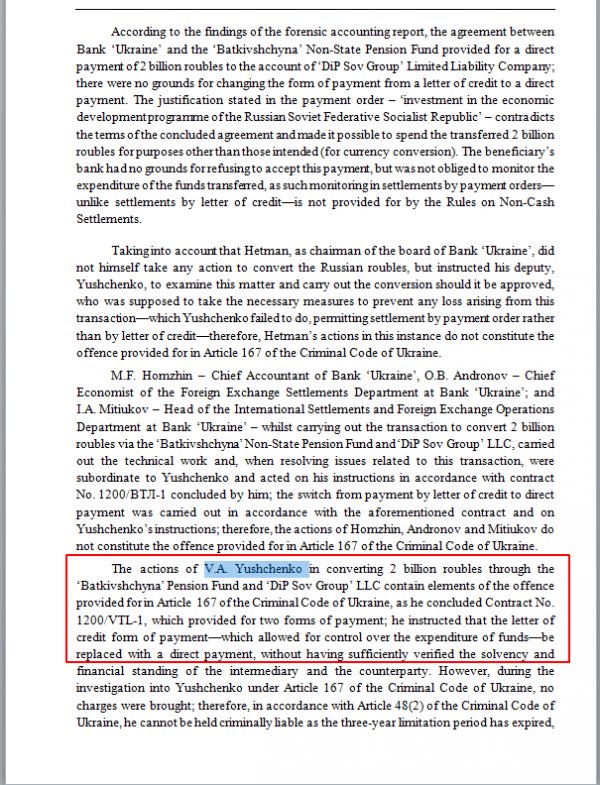
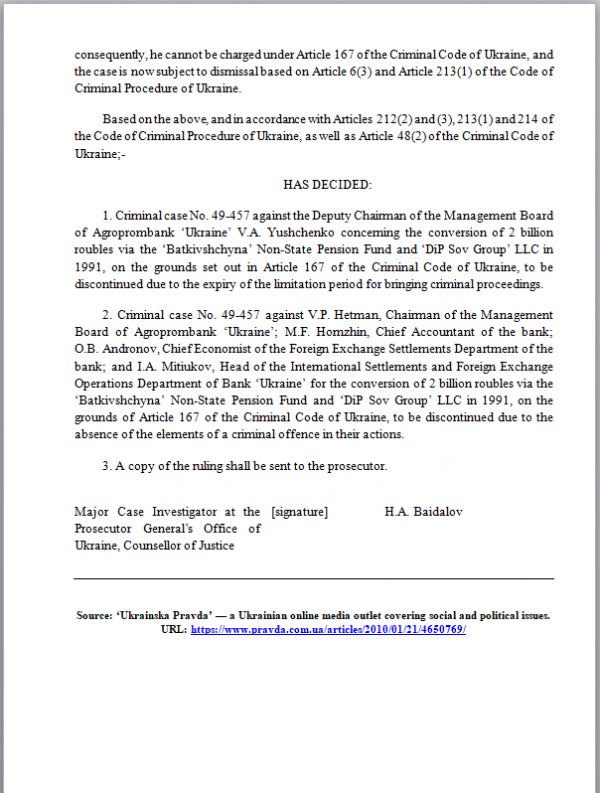
As it soon transpired, public criticism of the previous 'criminal regime' was necessary in order to return to it, and indeed to its highest echelons, not with the aim of dismantling the old 'criminal' SYSTEM, but to exploit it for even greater personal enrichment. It was these 'dear friends' and their 'political protégés' who initiated the massive destruction of professionalism within the governing bodies, of the legal framework designed to prevent corruption, and of the creation of new laws and subordinate legislation which only accelerated corruption and created the conditions for absolute impunity.
The legal system that had developed in Ukraine before the Orange Revolution was not perfect. But it was coherent and, together with the presence within Ukraine's law enforcement agencies of a critical mass of career professionals, more or less ensured the protection of Ukraine's national interests. Evidence of this included: the successful repulsion of the first attempt at Russian aggression near Tuzla Island in 2003; the prevention of bloodshed during the Maidan protests in 2004; and the thwarting of Yanukovych's first attempt to seize power in Ukraine through electoral manipulation.
Non-partisan professionals do not require instructions from the political leadership to fulfil their constitutional duty. For example, the security forces' initial response to the provocation near Tuzla Island and the SSU's first arrest of Police General Pukach in the Gongadze case in 2003 took place without consultation with the President. He was on official visits outside Ukraine at the time. He first learnt of the decisions and actions taken by the leadership of the security forces from the media. The decisions and actions taken by the SSU leadership in 2004 to halt the deployment of armed Internal Troops units into Kyiv to disperse the Maidan protests were also made without any prior political consultation.
Article 35 of the Law of Ukraine 'On the Security Service of Ukraine' still provides for independent decision-making within the scope of its officers' powers, as well as their duty to refuse unlawful orders. Unlawful actions and inaction result in liability: either disciplinary or criminal. Permanent staff of the SSU cannot be political appointees and have the status of military personnel. They were subject to the body of laws on military service. The politicisation of law enforcement and security agencies was initiated by Yushchenko. Under his leadership, loyal politicians began to be appointed to their leadership positions instead of permanent, non-partisan professionals.
Subsequently, ultra-wealthy political sponsors joined in, thereby finally transforming themselves into oligarchs, and their numbers began to grow. Let us not forget that before 2005, Pavlo Lazarenko could be considered the first and sole fully fledged oligarch. He was the only one among the ultra-wealthy who had a parliamentary party and his own media outlets, corrupt links within the leadership of law enforcement agencies and with international organised crime, and had a genuine chance of becoming the next President of Ukraine.
US national security archives, now declassified, show that the key success in the fight against corruption in Ukraine was achieved not by politicians, but through expert cooperation between non-partisan professionals from the Prosecutor General's Office, Ukrainian military intelligence and the US FBI. This is evidenced by the only successful special hearings for Ukraine held in the US Congress in April 1998 on combating international organised crime and corruption (https://www.govinfo.gov/content/pkg/CHRG-105shrg46099/pdf/CHRG-105shrg46099.pdf). It is also evidenced by the tragic fate of Yevhen Kostiuchenko, a captain in Ukraine's military intelligence, who was involved both in the investigation into Lazarenko's crimes and in those congressional hearings. Following the victory in 2000 of the SSU leadership, headed by L. Derkach, in their struggle against the leadership of the Main Intelligence Directorate of the Ministry of Defence, the latter was dismissed, and the unit in which Captain Kostiuchenko served was disbanded. He was forced to emigrate to the USA. He soon went on to have an outstanding career in the police there and was killed whilst on duty. A road in Ventura County, California, was named in his honour, and he was posthumously awarded the highest police honour in the United States... (https://ukrainainc.net/2023/03/06/11585/).
As we can see, even before 2005, there were serious problems in the work of special services and law enforcement agencies. The dissolution in 1998 of the Committee on Intelligence, which was, in essence, a betrayal of the military intelligence leadership in 2000, followed by political reprisals against it and the absolute trust placed in the head of the SSU, L. Derkach, resulted in the Сassette (also known as Tapegate) and Kolchuga Scandals and the tragedy surrounding the murder of Georgiy Gongadze. But by 2003, professionalism within Ukraine's security forces had been restored. This made possible the peaceful and bloodless Maidan of 2004.
The roots of yet another tragedy – the now bloody Maidan uprising of 2014 – were laid precisely in 2005. An imperfect but coherent system of professional appointments within Ukraine's security agencies was dismantled precisely after the Orange Revolution, initially under pseudo-'revolutionary' slogans during Yushchenko's presidency, and later – under pseudo-'democratic' slogans of endless 'reforms' and 'improvements' to organisational and staffing structures by his followers. Appointments to the leadership of the security and law enforcement agencies began to be made solely on political grounds, rather than based on career professionals. Under the 're-certification procedure', even general's ranks began to be bestowed upon such individuals. The fight against corruption not only failed to intensify but was practically scaled back. Corruption gained momentum, becoming more cynical and overt. It is now virtually unchecked...
In 2015, John Herbst, the US ambassador during the Orange Revolution, admitted that the hopes raised by the 2004 Maidan in the fight against corruption had not only failed to materialise but that corruption had actually worsened significantly.
"Ukraine has a very serious problem with corruption because, frankly, the very top of your elites are corrupt. The very top. I will not name them now, but even people at the very top, who know how to talk to Westerners in reform language and say all the right things, prospered under the old SYSTEM."
"They are able to jump from one party to another, in some cases, to manoeuvre between several parties – and, somehow, to remain untouched and to prosper. They learned to prosper under the old rules, and those rules are very convenient for them. And if they are convenient for you when you are a minister (in the previous government, which they criticised as soon as they lost their posts), imagine how convenient they will be for you when you are above that level. So these folks are a problem, but this is the leadership that you have...
... Civil society in Ukraine at independence was somewhat robust. That's why it is not surprising that you had a real democratic referendum on Independence in Ukraine, that you had a democratic transfer of power at the very first presidential election, or the second, when Kravchuk gave way to Kuchma, – and that was before the Orange Revolution! And the Orange Revolution would not have been possible without a mobilised civil society, albeit mobilised by corrupt leadership."
"...I had problems in my Embassy (I worked here from 2003 to 2006) because my Embassy were enthusiasts for the Orange team. And I remember telling them two things that were very important. One, the United States did not have a favourite candidate in that election. We were in favour of a fair election. And the second very important thing I said to them after Yushchenko went on the boards was: "Take a look at Yushchenko's team. How different they really are from the Kuchma's team or the Yanukovych's team?".
So I was one of the few people at the Embassy, or if that matters, in official Washington, who was not surprised when Yushchenko and Timoshenko fell out and when the Yushchenko government made the corrupt bargain on gas in January 2006, when the international community was looking forward to a win for Ukraine, and the destruction of all non-transparent gas relationships. But someone at the very top of Ukraine at that moment got very rich, rather than doing the right thing. And that PATTERN persists to this day – unfortunate but real (https://voxukraine.org/john-herbst-top-level-corruption-in-ukraine-ukr/).
Блог автора – матеріал, який відображає винятково точку зору автора. Текст блогу не претендує на об'єктивність та всебічність висвітлення теми, яка у ньому піднімається. Редакція "Української правди" не відповідає за достовірність та тлумачення наведеної інформації і виконує винятково роль носія. Точка зору редакції УП може не збігатися з точкою зору автора блогу.