CORRUPTION: laws to combat. Theses for the Plan and Strategy to Rebuild Ukraine (Part 6.2)
"For man, when perfected, is the best of animals, but, when separated from law and justice, he is the worst of all" (Aristotle, 4th century BC)
The nature of corruption and the laws governing the fight against it have long been known. American scholars, Professor Robert Klitgaard and Nobel laureate Gary Becker, have even derived scientific formulas for corruption. According to Professor Klitgaard, the equation is: C = M + D – A, where C stands for CORRUPTION, M for the MONOPOLY of power to make backroom decisions opaque to the public, D – DISCRETION in selective justice and impunity for officials and business tycoons close to power, and A – ACCOUNTABILITY and AUDITABILITY of those in power to society, the law and the justice system.
Professor Becker expresses this formula as a mathematical inequality:
(1 – P) • E (U) > R • S • L, where P is the probability of punishment for corruption, ranging from 0 to 1; (1 – P) is the probability of evading punishment for corruption; E (U) is the expected utility of corrupt activities; R is risk; S is the severity of punishment for corruption; and L is the lawful income from lawful activities.
According to these formulas, corruption becomes virtually unbeatable in countries governed by an authoritarian regime that is not accountable to society or to the laws of democracy, even when it calls itself a 'democracy', includes the word in its Constitution, formally holds elections and publicly performs ritualistic pseudo democratic procedures, in reality concealing and enabling the operations of privatised law enforcement agencies, security forces, courts and a distorted legal system that bears absolutely no resemblance to the laws of democracy (https://blogs.pravda.com.ua/authors/smeshko/68a5dd747bc1f/).
Has our country had any other path since 1991? Yes, it has. In the first year of Ukraine's independence, Zbigniew Brzeziński warned Ukraine against attempting to 'reinvent the wheel' when creating a new legal system that would comply with the principles of democracy. During a meeting in Washington with Ukraine's military attaché to the US, he advised adopting new laws immediately through a single package decision by parliament. This should have been precisely a comprehensive SYSTEM of laws from any Western country, one that had already been tested by the long-standing existence of a stable democracy.
'If you waste time searching for your 'own' democratic laws, you will end up with a host of oligarchs and a dysfunctional legal system. This will fuel state corruption. What matters is not the number of laws containing words about democracy, but effective justice and citizens' respect for the law as a national tradition. Benevolence should spur success, not invite ridicule due to an inability to 'adapt' to life with corruption."
I also recall a remark I received from the leadership of military intelligence at the time, following my suggestion to forward a transcript of this conversation with Dr Brzeziński to the President of Ukraine. I was told that this was purely a 'political matter' and did not pertain to the activities of a military attaché or military intelligence.

Only later, in a 2019 interview with The Day (Den) newspaper, did the first President, Leonid Kravchuk, confirm that no one in Ukraine's leadership knew how democracy ought to be built or understood the laws governing its existence (https://day.kyiv.ua/article/podrobytsi-litnya-shkola-zhurnalistyky/tsi-vybory-mozhut-buty-nashoyu-ostannoyu-pomylkoyu).
The process of building democracy in Ukraine remains unfinished precisely because the politicians who made strategic decisions lacked the necessary knowledge and genuine plans for its construction. Meanwhile, non-partisan professionals were not only deprived of the opportunity to make strategic decisions, but continue to this day to be silenced and prevented from being elected to political office in Ukraine.
Let us reiterate: the People of Ukraine, unlike those of Russia, are authentically European and, in their overwhelming majority, Christian. The global Ukrainian population stands at nearly 50 million. Christian cultural and moral traditions, just like European democratic traditions, are predominant in Ukraine. There are also Muslim Tatars living in Ukraine, but they number no more than half a million citizens. Geographically, Ukraine is situated in the heart of Europe, whilst to the north and east of its borders lie European Belarus and the European part of Eurasian Russia. Therefore, historically and naturally, Ukraine can have only one future – to be part of the pan-European civilisational and cultural space of the democratic European nations.
However, the development of modern forms of European democracy in Ukraine would be impossible without first formulating a Strategy – an architectural plan for such development – which is also necessary to raise the level of political culture within civil society. While society has learned to rise up against authoritarianism, it has yet to master electing a worthy government in its aftermath. It is precisely for this reason that we need to formulate and disseminate the principles for building modern forms of democracy and fundamental democratic values, which the new post-war elected representatives must adhere to and put into practice – not just in words, but in deeds.
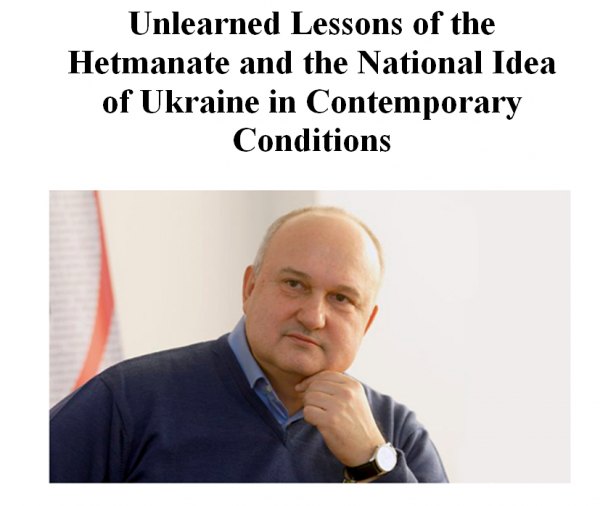
I formulated these three fundamental laws of democracy and published them ahead of the last presidential election in 2019 (https://day.kyiv.ua/article/den-planety/nevyvcheni-uroky-hetmanatu-ta-natsionalna-ideya-ukrayiny-u-suchasnykh-umovakh2). They were granted Copyright Registration Certificate No. 87693 on 11 April 2019.
The First Law of modern democracy can be defined as the law of the requisite development of the socio-economic foundation and the political culture of civil society aimed at ensuring the successful functioning of democratic institutions.
These must be sufficient to ensure the functioning of democratic institutions of government, public oversight of the authorities, and the necessary adaptation of the country's governance mechanisms to safeguard democracy in line with changes in both the domestic and international environments surrounding the country.
The Second Law of modern democracy, I believe, can be described as the law of the configuration (distribution, balance and checks) of the branches of government in a democracy.
It holds that genuine-rather than merely formal-electivity, accountability and transparency of the authorities in a democracy, as well as the equality of all citizens before the law, can only be ensured through the genuine separation of the three branches of government.
The Third Law of modern democracy can be described as the law of political stability, continuity and professionalism of public administration bodies in a democracy.
As a technocrat, I understand that democracy is an extremely complex socio-economic SYSTEM, far more complex than a technical one.
One such law is that any attempt to improve a single element of a holistic SYSTEM is guaranteed to impair the functioning of the SYSTEM as a whole.
Consider, then, the damage that has already been caused over the years of Ukraine's independence by the unsystematic reforms of its governing bodies... This was the cause of the two Maidan protests in Kyiv.
Блог автора – матеріал, який відображає винятково точку зору автора. Текст блогу не претендує на об'єктивність та всебічність висвітлення теми, яка у ньому піднімається. Редакція "Української правди" не відповідає за достовірність та тлумачення наведеної інформації і виконує винятково роль носія. Точка зору редакції УП може не збігатися з точкою зору автора блогу.