THE STATE PYRAMID and Essential Conditions for Building DEMOCRACY. Theses for the Strategy to Rebuild Ukraine. (Part 7.1)
"Many forms of Government have been tried, and will be tried in this world of sin and woe. No one pretends that democracy is perfect or all-wise. Indeed it has been said that democracy is the worst form of Government except for all those other forms that have been tried from time to time."
(Winston Churchill, speech in the British Parliament, 1947)
A few words on the 'world of sin and woe'. In our view, it is a synthesis of the material and the energetic, united into a single, highly complex system that operates according to the laws of our CREATOR – GOD. The individual components of this system are constantly in motion and changing, while the material can transform into the energetic and vice versa.
The unity and struggle between the material and the energetic give rise to the spiritual and serve as the source of the World's development. Within it, quantitative changes give way to qualitative ones; the past is superseded by the present; and development proceeds in a spiral in which progress and regression alternate, while the complex system can alter the quality of its own components.
The Laws of the Universe are objective and independent of human will. Human beings are part of it, and a micro-model of it is inherent in every person. This enables them to participate in either progress or regression – both in themselves and in the Universe.
Regression or progress depends on the degree to which Its Laws are understood and observed. Initial conditions, genetic code, heredity and the chosen purpose of a person's life are also significant. The 'spiritually enlightened' and 'spiritually dark' aspects within a person result from their life transformations. Different nations, religions, forms of government and the ideologies prevailing in societies also influence the fate of each individual Human Being.
Let us now turn to forms of government in different countries and amongst different peoples. Human history has seen many such forms. Authoritarian regimes have predominantly prevailed in Asian countries, for instance, whereas European nations have leaned toward democratic ones. At the same time, no form is uniform or static.
If we were to place them all on a single straight line, its extreme points would be absolute autocracy, effectively a dictatorship, and full democracy, the ideal of popular sovereignty, which is very difficult to achieve, while the form of government requires constant adaptation to new conditions of existence. The primary distinction between them lies in their objective function – the very purpose of the state's existence.
For an authoritarian country, the supreme values are the size of its territory, the number of its subjects, and the personal 'glory' of the dictator. Dictators regard everything in the country as their personal property. For democratic countries, the core values are individual freedom and dignity of citizens, the rule of law and their equality before the law, as well as the protection of private property rights.
All forms of government that lie between these two extremes represent various combinations of autocracy and democracy. Their shift and transformation toward one form or another depend on the internal and external conditions in which countries and peoples find themselves, and on changes in the state and quality of societies, elites, ideologies, and governments. Moreover, such changes can be either gradual – evolutionary – or revolutionary.
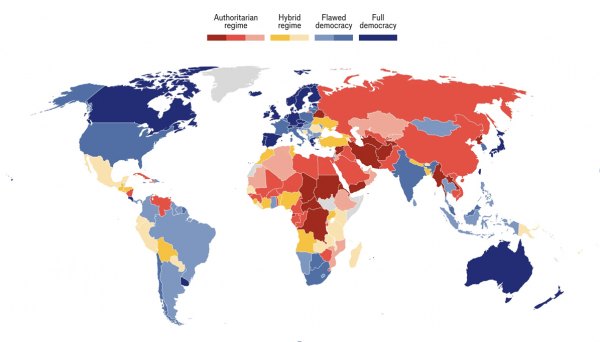
For example, democracy in the US during the presidencies of Nixon and Trump represents two distinct forms of democracy. Although President Trump did not come to power through revolutionary means, he has transformed the face of the country in an almost revolutionary way. He is evidently inclined toward an authoritarian style of governance, makes no secret of his admiration for dictators, avoids unequivocally condemning military aggression, shows a contradictory attitude toward the norms of international law, and has significantly altered the traditional focus of US foreign policy on protecting freedom and democracy worldwide.
But what ESSENTIAL CONDITIONS FOR THE CONSTRUCTION OF A MODERN DEMOCRACY can we discuss based on the knowledge accumulated by Humanity to this day?
Some of these were formulated and published in 2018 in the newspaper 'Den' ('Day') in the article entitled 'The Unlearned Lessons of the Hetmanate and Ukraine's National Idea in the Modern Context' (https://day.kyiv.ua/article/den-planety/nevyvcheni-uroky-hetmanatu-ta-natsionalna-ideya-ukrayiny-u-suchasnykh-umovakh2).
They were even granted the corresponding national copyright registration certificate (No. 87693 dated 11 April 2019). Building on these, we will expand upon and formulate the following:
The first condition - 'THE MIDDLE CLASS AS THE SOCIAL BASE FOR DEMOCRACY'
This means that a necessary but insufficient condition for the existence of democracy in a country is the presence of a critical mass of the MIDDLE CLASS.
As Aristotle famously observed in his treatise Politics, 4th century BC: 'a state composed of "middle" people will have the best form of government'.
According to Aristotle, the 'MIDDLE' in a country must be stronger and more numerous than the 'richest' and 'poorest'. The former will always buy their way into power and strive to become oligarchs, whilst the latter will 'sell themselves' in elections and 'dream of having their own slaves'. The result will be that corrupt wheeler-dealers or venal, smooth-talking populists will come to power, controlled by oligarchs.
Let us also recall that democracy in Aristotle's time existed in small city-states. It applied only to free citizens and did not grant the right to vote to the majority of the population – slaves, as well as foreign-born residents, even if free. Aristotle believed that increasing the number of voters beyond 5,000 also posed a threat to democracy. Those who come to power will be people whom the voter does not know personally. Without living alongside them 'in plain sight', the voter cannot verify the true backgrounds of candidates for office or distinguish their 'empty' words from their 'genuine' deeds.
In modern democratic countries, the middle class must comprise at least 50 per cent of the population. This class must include the scientific and creative intelligentsia, doctors, teachers, military personnel, civil servants, engineers, highly skilled workers, representatives of small and medium-sized businesses, as well as pensioners. Without such a social base – a self-sufficient middle class – there is simply no foundation upon which to build the state pyramid of democracy.
The second condition is - 'A TWO-PARTY SYSTEM AS THE POLITICAL FOUNDATION FOR DEMOCRACY'
This means that even if a country possesses a social base for building democracy, its establishment is impossible without the presence of political parties that genuinely strive to build it, recognise the existence of the laws of democracy, and possess a programme and strategy-a kind of 'architectural plan'-for such construction.
Humanity's accumulated experience shows that DEMOCRACY requires not only THE PEOPLE, who historically strive for FREEDOM and JUSTICE, but also a corresponding POLITICAL ELITE of such PEOPLE, who know how to build it. To this end, such an ELITE must be organised into at least TWO non-leader-centred political parties or two blocs of parties, which recognise the existence of the laws of democracy and differ from one another only in their ideological orientation: one with a conservative outlook, and the other with a liberal vision of the World.
Sharing a common belief in DEMOCRACY, they must differ only in their ideological outlook. For one, this vision is rooted in time-tested conservative traditions, primarily of their own people, and in the historical experience of past generations. For the other, it stems from the liberal views of other nations, which have often not yet been tested by their own country's history, but have already proven their success in the world's most advanced nations. Both must share unquestionable patriotism and a commitment to democratic values: electivity, accountability, and the openness of state authorities to a developed civil society.
Without such parties or coalitions in the country, along with the media that support them, no one will raise voters' political awareness, teach them the principles of democracy, or transform the population into a developed civil society. Their place will inevitably be taken by puppet oligarchic parties, corrupt politicians and media outlets controlled solely by them, who are interested not in the rule of the people through DEMOCRACY, but in personal AUTHORITARIAN power – behind the smokescreen of pseudo-democracy.
They are easily recognised not by their populist rhetoric and pseudo-patriotic slogans, but by their actions. Such pseudo-democratic parties actively seek to destroy, first and foremost, the country's professional elite and the reputation of decent and moral candidates for office. They do this by ignoring them and silencing them in the media, or by 'labelling' them and resorting to smear campaigns. The aim is to promote artificially created 'new faces', 'young politicians', 'civil society activists' and 'selfless volunteers' in place of patriotic professionals. The result is that, instead of democracy, there is covert authoritarian governance of the country.
When asked why exactly TWO parties or TWO party blocs are needed, the answer is simple. In a DEMOCRACY, a single GOVERNMENT must be checked by a single OPPOSITION. Each party or party bloc must have a RESERVE OF PERSONNEL both for governing in GOVERNMENT and for exercising oversight in OPPOSITION. They must always be ready not only to govern, but also to exercise oversight. This must occur without breaking the law, in accordance with the PROCEDURES laid down by law, and respecting the democratic principle of the rule of law in the country above their own ideological conservative or liberal worldview.
A natural name for such parties could be: the Conservative-Democratic and Liberal-Democratic Parties. The very names of the parties define their main political goal – the building of DEMOCRACY – and also emphasise the ideological foundation for seeking out materials and builders: conservative and liberal ideologies. These are important, but they are secondary to the architectural blueprint for the project – the STATE PYRAMID OF DEMOCRACY. This architectural plan must remain unchanged for both parties, as must their understanding that the destructive clash of their ideologies-with a hidden attempt to replace the architectural plan for democracy with a plan for building an AUTOCRACY-has, on more than one occasion, led to the victory of fascist dictatorships in Europe.
The third condition is - 'THE BALANCE OF POWER AS THE LEGAL FOUNDATION FOR DEMOCRACY'
This means that genuine, rather than merely declared, electivity, accountability, and transparency of the authorities under democracy, as well as the equality of all citizens before the law, can be ensured only if there is a division and separation of the three branches of POWER: LEGISLATIVE, EXECUTIVE, and JUDICIAL.
This separation must be real, not merely declared, and any infringement upon it by the executive branch must be regarded as a direct threat to democracy and an act of treason. The oversight functions of the OPPOSITION over the executive branch of POWER must be PROCEDURALLY DEFINED by a specific law, which is particularly important in countries with no established historical traditions of such oversight or where these are not enshrined in the Constitution.
The Constitution must function as an unquestionable law of direct effect, with trial by jury serving as the highest form of justice. Since the prosecution's case in court is based on evidence gathered by state law enforcement agencies, protecting citizens must rely on potential counter-evidence gathered by private detectives.
Meanwhile, most government functions should be devolved to the lowest possible level of government – LOCAL SELF-GOVERNMENT – while law enforcement functions should be divided into municipal and national components.
The fourth condition - 'THE STABILITY OF GOVERNMENT BODIES AS THE KEY TO PRESERVING THE INSTITUTIONALITY AND PROFESSIONALISM OF GOVERNMENT UNDER DEMOCRACY'
This means that, in a country where political power is constantly re-elected, preserving stability, professionalism, and institutional memory within government bodies is possible only if these bodies retain a critical mass of non-partisan professional staff. Moreover, their career progression must be protected by law from unlawful political influence and the arbitrariness of politically motivated personnel decisions.
Politicians, as a rule, change in power after every election. Their professional competence may be secondary in politically motivated appointments. Their subordinates, non-partisan professionals, climb the career ladder over decades. Within these bodies, they serve as the sole custodians of institutional memory, expertise and established professional traditions. Therefore, the protection of such professionals from unlawful influence by politicians must be regulated by a specific law. Any breach of this law must entail criminal liability for undermining the stability of the state and democracy.
Responsibility for concealing or ignoring such destructive practices that weaken and erode state institutions rests not only with the ruling power but also with the opposition. The media-the fourth pillar of non-state power in a democracy -must also bear particular responsibility. Their silence and failure to draw attention to such facts is an indicator that there is no freedom of speech in the country, and that the media are under the control of corrupt authorities and oligarchs.
The fifth condition - 'AN INNOVATIVE-PRODUCTIVE AND TECHNOLOGICAL-PRODUCTIVE MODEL AS THE ECONOMIC FOUNDATION FOR DEMOCRACY'
This means that only a strong, self-sufficient economic model with stable macroeconomic growth can, under current circumstances, serve as the basis for building a DEMOCRACY in the country. Without such a foundation, it is impossible to ensure either the socio-political basis for its establishment or the defence capability of an existing democracy in a hostile external environment.
We must not forget that the main external enemies of any modern democracy will always be authoritarian regimes, which fear the success of democracies as an example to their own peoples. Equally hostile are also transnational profiteers and corporations, which promote the ideas of globalism to plunder the natural and human resources of other countries around the world. They have no interest in a strong economy or effective governance in the countries they plunder.
Similarly, no joint plans or strategies exist to strengthen the economic power of countries building democracy, not even among the world's democratic nations, the EU, or NATO. Their own national interests and benefits will always take precedence.
Thus, self-sufficiency, high productivity and the efficiency of one's own national economy remain the sole resource for the economic underpinning of the construction of DEMOCRACY. The model of the modern economy can be formulated as follows: PRODUCTIVE FORCES + TECHNOLOGY + INNOVATION + FINANCIAL AND HUMAN CAPITAL + HEALTHY DEMOGRAPHY AND ECOLOGY.
Implementing such an ECONOMIC MODEL is possible only if the state guarantees support and protects national interests in the following areas: Science, Education, Healthcare, Demography, and Ecology. (https://blogs.pravda.com.ua/authors/smeshko/6992f118d545d/).
Thus, DEMOCRACY is an extremely complex, multi-level hierarchical SYSTEM that, in turn, consists of interconnected, complex subsystems. Moreover, only a correctly structured entire STATE PYRAMID as a whole can ensure the coordinated functioning of all elements of the state: society, the elites, the economy and state governing bodies – to fulfil the PURPOSE – the intended function of DEMOCRACY: to ensure freedom, the rule of law and equality of all citizens before the law, as well as to protect citizens' dignity and their rights to land and private property.
Furthermore, this SYSTEM also operates according to the objective laws of NATURE, namely the principles of complex systems theory. One such principle is that any attempt to improve a single element of a complex system is guaranteed to impair the functioning of the system as a whole. An individual element of the system can only be improved following a prior analysis of its place within the hierarchy of the system as a whole. This must be preceded by an analysis of this element's connections with others, its impact on the purpose and intended function of the system as a whole, as well as the impact of the external environment on all elements of the system.
Consider, therefore, the immense damage inflicted throughout the years of Ukraine's independence by unsystematic reforms of its governing bodies. This was the direct consequence of individuals coming to power who lacked even a basic understanding of system analysis and synthesis – skills required even for simpler, technical systems. Yet they boldly interfered in the processes of so-called democratic state-building, in reality destroying its nascent foundations within the authorities. Shielding themselves behind pseudo-democratic rhetoric, they attempted to copy an oligarchic-clan authoritarian governance model akin to the Russian one. This had devastating consequences for Ukraine's defence capabilities and further provoked Russia into its 2014 aggression.
However, we shall explore this in greater detail in the continuation...
Ukrainian version: https://blogs.pravda.com.ua/authors/smeshko/6abd3f84e9d18/
Блог автора – матеріал, який відображає винятково точку зору автора. Текст блогу не претендує на об'єктивність та всебічність висвітлення теми, яка у ньому піднімається. Редакція "Української правди" не відповідає за достовірність та тлумачення наведеної інформації і виконує винятково роль носія. Точка зору редакції УП може не збігатися з точкою зору автора блогу.