THE STATE PYRAMID AND THE LAWS OF DEMOCRACY. Theses for the Strategy to Rebuild Ukraine (Part 7.2)
'You never change things by fighting the existing reality. To change something, build a new model that makes the existing model obsolete' (Richard Buckminster Fuller (1895-1983))
'In 1991, we proclaimed that Ukraine had become a democratic state. We suddenly began to build a new state. We had no knowledge of the new system, even though we were educated people... Yet that knowledge was fundamentally at odds with what we needed in the new Ukraine. This state of affairs persists to this day' (President of Ukraine Leonid Kravchuk (1934-2022))
No one begins building a palace without an architect, a blueprint, and the appropriate craftspeople and materials. Builders must possess a clear vision of the structure they are building and understand the principles of architecture.
Building such an extremely complex political, administrative, legal, economic and social system as DEMOCRACY is even more difficult. This construction must involve not only the country's political and professional elites, but society as a whole. The elites must know what to build and how to build it, and must manage the construction process, while society must take an active part and ensure that the state pyramid thus constructed complies with the laws of democracy.
Thus, the formulation of the laws governing its architecture – the model of the STATE PYRAMID and the LAWS OF DEMOCRACY – is an essential prerequisite both for its construction and for maintaining its condition and restoring the existing structure.
For countries embarking on such a project, this offers an opportunity to analyse mistakes and use the final model as a benchmark. For 'old democracies', it serves as a guide for restoring outdated and replacing degraded structural elements.
The underlying cause is clear: neither elites nor societies are static-they evolve continuously. Democracies, however, always perish because of unchecked corruption and the degradation of elites and societies, as well as the shrinkage of the middle class and the decline in the political culture of the electorate. The external enemy of democracies is the world's authoritarian regimes.
It is worth recalling that all Western democracies originated in Europe. Only on this continent have they developed over millennia and formed certain democratic traditions. But at present, millions of migrants are arriving in the West from countries where there are no democratic traditions.

For many of them, clan-based structures and authoritarianism are more familiar and traditional forms of social relations. Failure to take these factors into account is already contributing to a certain decline in democracy, even in the US, which until recently was the leader of the democratic West. The recent setting on fire of a firefighter during schoolchildren's riots in Bordeaux is a challenge to France's 'old democracy', the cradle of the European Enlightenment. Particularly striking are the faces of the schoolchildren who carried out this act, mostly from migrant families, who cynically watched as a human being suffered.
For far too long, all democratically elected US administrations failed to recognise the tectonic shifts taking place within societies and elites around the world following the end of the Cold War. These changes have weakened democracies and strengthened authoritarian regimes in a number of nations. Communist authoritarianism, in particular, gained strength by transitioning to a capitalist economic model and securing access to Western technologies and markets.
The lack of US leadership led to a lost decade that should have been used to prepare for a possible active phase of the Third World War. Unnoticed by the West, this war was quietly unleashed by Russia in Ukraine as early as 2014, beginning with the annexation of Crimea-under the Kremlin's fully explicit banner of a 'war against the collective West.' From that time until the present day, the war in its active phase has been waged solely against Ukraine, but in other hybrid forms – against the entire 'collective West'.
Unfortunately, all this happened despite Ukraine's early warnings to the West.
(https://www.lefigaro.fr/mon-figaro/2014/03/20/10001-20140320ARTFIG00304-general-smeshko-poutine-place-l-europe-au-bord-d-une-troisieme-guerre-mondiale.php)
(https://blogs.pravda.com.ua/authors/smeshko/61cc88f72e5f8/) (https://blogs.pravda.com.ua/authors/smeshko/62151173a480b/) (https://blogs.pravda.com.ua/authors/smeshko/67cb50126ccbd/) (https://blogs.pravda.com.ua/authors/smeshko/6815eb243fcc4/)
Ignoring these warnings has undermined the international legal system that emerged after the Second World War. The UN Charter, the 1975 Helsinki Final Act, the 1969 Vienna Convention on the Law of Treaties, the 1968 Treaty on the Non-Proliferation of Nuclear Weapons and the related 1994 Budapest Memorandum have ceased to act as safeguards against the Third World War. A conflict that has long been smouldering on the brink of a possible transition into a full-scale hot war and needs to be called by its proper name: the aggression of collective authoritarianism against the world's divided democracies.
Western governments and intelligence services proved unprepared to organise, in good time, a collective defence of DEMOCRACIES in the face of the growing economic and military might of the world's AUTHORITARIAN REGIMES, which, since 1991, have gradually and inexorably, utilising the West's finances, technology and markets, have been building up their strength whilst simultaneously weakening Western democracies.
(https://blogs.pravda.com.ua/authors/smeshko/68b5ebc21a8c2/) (https://blogs.pravda.com.ua/authors/smeshko/69bd656287687/)
So, what do the STATE PYRAMID and the LAWS OF DEMOCRACY represent in the modern world? Knowledge of these models and laws is necessary, for example, for Ukraine to build a DEMOCRACY, and for the West to restore outdated elements of its institutional architecture and adapt them to new conditions.
At the base of such a PYRAMID: A – the country's economic model; B – the country's political system model; C – the model of the army, security forces and law enforcement agencies; D – the model of regional organisation and local self-government; and O – the country's social model. At the apex of the pyramid is P – the model of the country's elites, including political and professional (expert) elites.

The vertices A and B of such a pyramid are linked via the model of the country's property relations and legal system; B and C – via the model of control over the country's security forces - the army, secret services and law enforcement agencies; C and D – via the model of protecting and preserving the country's national, cultural, religious, and historical values and traditions; A and D – via the model of governance in the fields of science, education, healthcare and the environment; A and C – via the model of governance of the military-industrial complex (MIC), the provision of defence forces and the arming of the army; B and D – via the model of administrative and legal control over local self-government.
The lateral edges of the pyramid correspond to: AP - the model for the legal and organisational framework for combating corruption; BP – the model for the legal framework ensuring the separation of powers into legislative, executive and judicial branches, and the mutual checks and balances between them; CP – a model for the legal protection of professional civil servants in government bodies against unlawful political influence; DP – a model for the legal protection of freedom of speech and information in the country.
All elements of the pyramid are interdependent. Only together do they form a coherent system with a new quality, which none of its elements possesses on its own. Only together, united into a single SYSTEM, can they ensure the personal freedom and dignity of the country's citizens, the rule of law, equality before the law, and the protection of private property rights. They also guarantee the external and internal security of the country as a whole.
THE STATE PYRAMID, constructed in accordance with the LAWS OF DEMOCRACY, has a regular form. Shapes that deviate from a regular form signal a departure from democratic principles-a sign that democracy is degenerating into autocracy and degrading its performance of core functions.
Countering these destructive processes requires a systemic approach to executing the laws of democracy. The principle underlying this approach is that any attempt to improve a single element of the system without considering its interconnections with other elements is guaranteed to impair the quality of the system as a whole.
Before formulating the LAWS OF DEMOCRACY, let us recall who contributed to the acquisition of this knowledge and its scientific description.
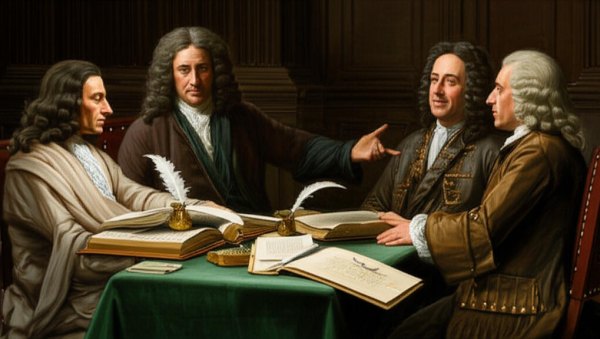
Aristotle (4th century BC). In his work 'Politics', he analysed various forms of state governance and identified the conditions for the stability of the state system, which remain important for modern democracy. These include balancing interests among different social groups, citizen participation in public affairs, and preventing any single group from dominating solely in its own interests. He attached particular importance to the middle class as the primary stabilising force in society and the pillar of a stable state system.
Charles-Louis de Montesquieu (1689-1755). In his work 'The Spirit of the Laws' (1748), he systematically justified the principle of the separation of state power into legislative, executive and judicial branches. He regarded the concentration of these branches of power in a single set of hands as a threat to political freedom and a path to arbitrariness and tyranny. This led to the need to separate the branches of power, maintain a balance between them, and ensure mutual checks and balances. Without this, it would be impossible to prevent democracy from degrading into autocracy and tyranny.
Jean-Jacques Rousseau (1712-1778). In his work 'The Social Contract' (1762), he set out the ideas of popular sovereignty and direct citizen involvement in law-making. The people are the legitimate source of power, and laws must express the general will, directed toward the common good, rather than the private interests of individuals or groups. In effect, he recognised the interconnection between the quality of society and the elites and the quality of laws and the country's governance, which cannot exceed the prevailing political culture.
John Stuart Mill (1806-1873). In his works 'On Liberty' (1859) and 'Considerations on Representative Government' (1861), he linked the success of representative democracy to protecting citizens' personal liberty, freedom of thought, and open public debate. This reinforced Aristotle's conclusion regarding the importance of a strong middle class in a country. He identified a pattern whereby the level of a society's culture influences the quality of public administration. Under this pattern, an educated population and free, honest media are essential conditions for successful democratic governance.
Robert Dahl (1915-2014). In his work 'Polyarchy: Participation and Opposition' (1971), he identified institutional safeguards to assess the degree of democracy in a political system. These include freedom of speech, free access to information, the freedom to form civil society organisations and participate in their activities, and fair elections with the active participation of the majority of the country's citizens.
Seymour Martin Lipset (1922-2006). In his work 'The Political Man' (1960), he examined how economic development and social conditions influenced the emergence and stability of democracy. He showed that a developed economy, rising standards of living and education, and a stronger middle class create favourable conditions for democratic governance. He argued that only a developed, robust economy can foster the emergence of democracy. The quality of governance and the stability of democratic rule depend on the level of education and social engagement of the country's citizens.
Francis Fukuyama. In his work 'The End of History and the Last Man' (1992), he analysed contemporary forms of democracy. As a proponent of liberalism, he, in our view, drew the erroneous conclusion that liberal democracy is a universal form of government. This contradicts the facts and human experience. However, he emphasised an important principle of democracy: strong institutions of power are essential to its preservation. Incidentally, this is something championed not primarily by globalists and liberals, but by conservatives.
Drawing on the knowledge and experience accumulated by humankind, let us now attempt to formulate THE LAWS OF DEMOCRACY in the modern world.
THE FIRST LAW OF DEMOCRACY is the law of the necessary level of development of the socio-economic base and political culture of civil society to ensure the functioning of the institutions of power in a democracy.
This law states that the necessary but not sufficient conditions for the existence of a thriving democracy in a country are the presence of a critical mass of a wealthy middle class and a certain level of political culture in its civil society, which should be sufficient to ensure the functioning of democratic institutions of power in the country, control over them by civil society and adaptation of their management algorithms depending on changes in both the internal and external environment around the country.
THE SECOND LAW OF DEMOCRACY is the law of the configuration (distribution, balance and counterbalance) of the authorities in a democracy.
This law states that real, not formal, elected government, accountability and transparency of government in a democracy, as well as equality of citizens in the eyes of the law, can only be ensured if there is a separation of powers between the legislative, executive and judicial branches of government, and if the majority of internal functions of the state are transferred to the lowest possible level of government, to local self-government bodies.
THE THIRD LAW OF DEMOCRACY is the law of the conditions for political stability, sustainability and professionalism of public administration in a democracy.
This law states that a necessary but insufficient condition for government stability in a democracy is the existence in the country of at least two parties or party blocs that are ideologically committed to democracy. These parties differ only in their worldview – whether conservative or liberal – but are united by their commitment to democracy and adherence to its principles: the election of representatives, accountability and the openness of government to society. Each of these parties must have a pool of qualified personnel and be professionally capable of both forming a government and managing its work, and of scrutinising it while in opposition.
At the same time, the continuity and professionalism of state administrative bodies must be ensured, firstly, by a legally defined system to provide protection for professional civil servants – the custodians of institutional memory, continuity and professionalism within state administrative bodies – from unlawful political influence by temporarily elected or politically appointed leaders, who may change after every election; secondly – freedom of speech and the independence of the media from covert influence by the authorities or oligarchs.
These LAWS OF DEMOCRACY are system-defining. They were formulated and published in 2018 in the newspaper 'Den' in the article 'The Unlearned Lessons of the Hetmanate and Ukraine's National Idea in the Modern Context'. They have been nationally registered and are protected by copyright No. 87693 dated 11 April 2019. They may be supplemented by further framework-defining laws, which are derived from these three and relate to specific models of governance – elements of the STATE PYRAMID OF DEMOCRACY.
THE FOURTH LAW OF DEMOCRACY is the law of checks and balances in a democracy.
It holds that the implementation of the principles of democracy – the rule of law, the principle of elected government, the openness and accountability of the authorities to society, the equality of citizens before the law and the protection of freedom of speech – is possible only provided that the separation of state power into legislative, executive and judicial branches is enshrined in the Constitution and in law. Another essential condition is the presence in the country of a fourth, non-state element of control over the authorities – independent media and trade unions committed to the principles of democracy.
Each branch of government must, within the procedures defined by law, exercise control over one another. The parliamentary opposition must exercise control over the government's personnel, financial, administrative and organisational activities. The Constitutional Court must ensure that the government and parliament unconditionally comply with the provisions of the Constitution as directly applicable norms. At the same time, all branches of government must be subject to public scrutiny, particularly through independent media and trade unions.
Attempts and actions by the government to unlawfully subordinate the legislative and judicial branches, the media, and trade unions to narrow party or oligarchic-clan interests, as well as the creation of government-controlled non-governmental organisations to exert a monopoly on public opinion, must be regarded as a threat to the constitutional foundations of democracy.
THE FIFTH LAW OF DEMOCRACY is the law of the quality of government in a democracy.
It holds that the quality of government bodies in a democracy depends on the quality of the political elites whom voters elect to power and cannot exceed the quality of the voters' political culture. The prerequisite for the existence of an independent voter in a country is a middle-class majority. Any government that reduces its numbers is, in essence, authoritarian. The current government, the parliamentary opposition, and the country's media and civil society organisations are responsible for developing the electorate's political culture.
The latter's task is to inform society impartially and objectively about the principles of democracy and to provide verified information on the professional and moral qualities of candidates for the ruling political elite.
This elite comprises those elected to power or appointed under political quotas. They become politicians and are granted the authority to make strategic decisions within the state, a power which professional civil servants in government bodies do not possess. Concealing key facts about candidates, biased coverage of their activities, and promoting unqualified populists under the guise of 'activists' or 'new faces in power' misinform voters and contribute to the deprofessionalisation of government. In essence, this is a betrayal of democracy and a means of aiding the oligarchs in transforming it into a covert autocracy. Responsibility for deliberate disinformation lies, in particular, with corrupt journalists, political scientists, sociologists and civil society activists who participate in such actions.
THE SIXTH LAW OF DEMOCRACY is the law of the two-party system and parliamentary opposition in a democracy.
It implies that the government, the executive branch of government, will always be tempted to unlawfully extend the term in office of the political force that formed it. Therefore, the government must be subject to constant scrutiny by the legislative branch, in particular by the political force that forms the parliamentary opposition. The scope, extent and procedures for such scrutiny must be defined by law, whilst the principle itself must be enshrined in the Constitution.
Any government, even one democratically elected, will always have the opportunity to use the country's resources-financial and material, administrative and personnel, as well as law enforcement mechanisms and the means of state coercion-in a non-transparent manner. The temptation to use these resources to serve narrow party, oligarchic-clan or private interests will always exist amongst those in power. Only the parliamentary opposition can monitor and restrict the activities of corrupt politicians. It should be assisted in this by non-partisan career professionals within government bodies, independent media, trade unions and civil society.
To exercise parliamentary control, parliament must have two parties, or blocs of parties, ideologically committed to democracy. Both must be prepared to act professionally in government and in opposition, and, to this end, have a pool of qualified personnel and prepared action plans. The difference between them should lie solely in their worldview: one operating from conservative principles, and the other from liberal ones.
THE SEVENTH LAW OF DEMOCRACY is the law of professionalism, stability and institutional memory of state administrative bodies under democracy.
It states that professionalism, stability, and institutional memory in state administrative bodies under democracy, amid constant changes in senior political leadership, depend on the professionalism of their non-partisan civil servants. It is they who embody these qualities within government bodies; they must form the backbone of the civil service, ensuring the preservation of professional ethics and professional traditions regardless of the narrow party affiliations of their temporary political leaders.
The priority of their work must be ensuring the rule of law and protecting the Constitution as the country's Fundamental Law and the national interest, rather than narrow party-political interests defined by law. They must prevent and counteract unlawful actions within the limits of their powers and in accordance with procedures established by law, in particular when such actions threaten the country's security and defence or violate the provisions of the Constitution. In doing so, they must be guided by the Constitution and the principles of democracy: to serve the entire nation, not just the section that voted for the new political leaders of state administrative bodies in the last election.
The rule of law must be balanced through a system of civilian control over career military personnel and civil servants in state administrative bodies. They must be prohibited by law from joining political parties and participating in political activities. At the same time, this prohibition must be balanced by a statutory ban on dismissing career civil servants on political grounds. Such actions, as well as attempts at unlawful narrow-party or clan-based influence over the professional activities of career civil servants, must be regarded as violations of constitutional guarantees and democratic principles, and as a threat to the state.
We shall discuss, in the next part, how these laws can be used to analyse the mistakes made in the construction of democracy in Ukraine to date, as well as to adapt and provide protection for the 'old democracies' in the West in the current circumstances of their existence...
Блог автора – матеріал, який відображає винятково точку зору автора. Текст блогу не претендує на об'єктивність та всебічність висвітлення теми, яка у ньому піднімається. Редакція "Української правди" не відповідає за достовірність та тлумачення наведеної інформації і виконує винятково роль носія. Точка зору редакції УП може не збігатися з точкою зору автора блогу.